kimono.mom
📖78 Terms

Kimono Glossary

着物用語辞典

A comprehensive guide to the specialized terminology of Japanese kimono — from structural parts to fabric techniques, patterns, and accessories.

🔍
👘

Kimono Structure

着物の構造

The fundamental parts that make up a kimono garment — from collar to hem.
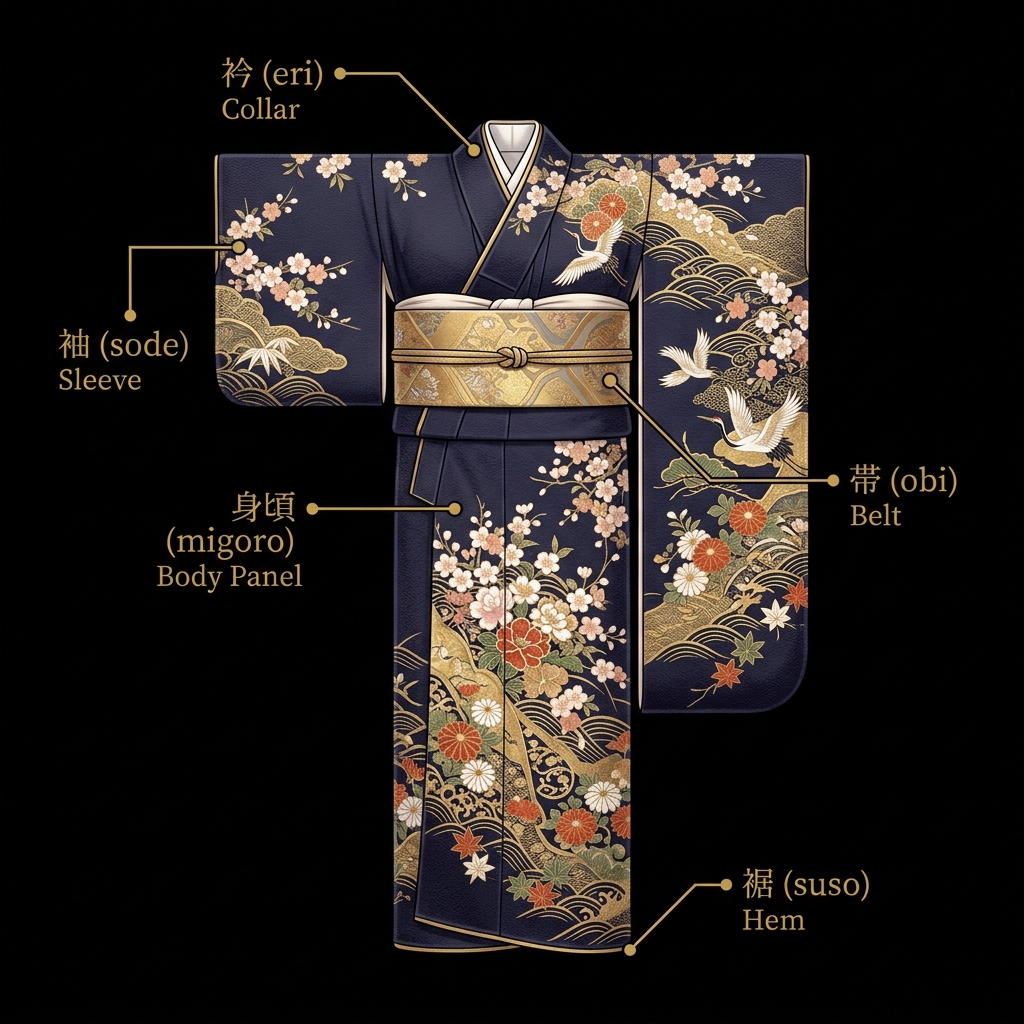
10 terms
Kimono Structure
Loading...
身頃Migoro
Body Panel
The main body panel of the kimono. Consists of front (mae-migoro 前身頃) and back (ushiro-migoro 後身頃) panels.
Okumi
Front Overlap Panel
A narrow panel sewn to the front body panel to create the overlapping neckline.
Eri
Collar
The collar of the kimono that frames the neckline. Always worn with the left side over the right.
半衿Han-eri
Inner Collar
A decorative half-collar sewn onto the nagajuban that peeks above the kimono collar.
掛衿Kake-eri
Collar Guard
A protective fabric strip sewn over the outer collar to prevent wear and staining.
衣紋Emon
Nape Opening
The gap at the back of the collar that reveals the nape of the neck.
Suso
Hem
The bottom edge/hem of the kimono.
身八つ口Miyatsukuchi
Side Opening
An opening under the armpit between the body panel and the sleeve, found on women's kimono.
胴裏Doura
Body Lining
The lining fabric for the upper body section of a lined (awase) kimono.
ふきFuki
Hem Padding
The slight padding or rolled edge at the hem that gives weight and structure.
🎐

Sleeves

袖の部位

Sleeves are one of the most expressive parts of a kimono — their length and shape communicate status and occasion.
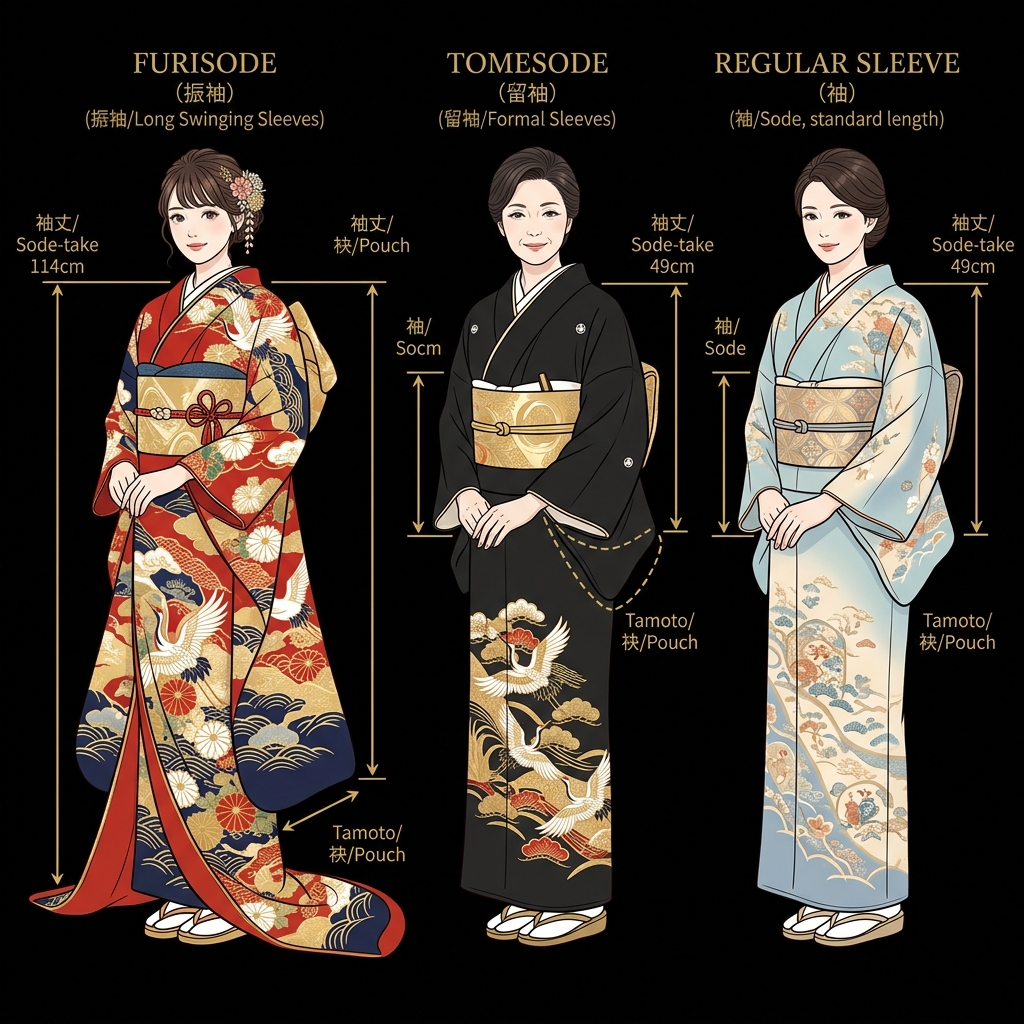
7 terms
Sleeves
Loading...
Sode
Sleeve
The general term for the kimono sleeve. Unlike Western sleeves, kimono sleeves form a pouch-like bag shape.
Tamoto
Sleeve Pouch
The lower, bag-like portion of the sleeve that hangs down.
袖口Sode-guchi
Sleeve Opening
The wrist opening of the sleeve where the hand passes through.
振りFuri
Sleeve Swing
The open section at the back of the sleeve (between body and sleeve back edge) on women's kimono.
袖丈Sode-take
Sleeve Length
The vertical measurement of the sleeve from shoulder to bottom edge.
肩幅Kata-haba
Shoulder Width
The measurement from the center back seam to the shoulder-sleeve joint.
振袖の種類Furisode Styles
Long Sleeve Types
Three lengths exist: Ō-furisode (大振袖, 114cm), Chū-furisode (中振袖, 95cm), and Ko-furisode (小振袖, 75cm).

Collar & Neckline

衿元の用語

The collar area is the focal point of kimono dressing — subtle adjustments communicate elegance and propriety.
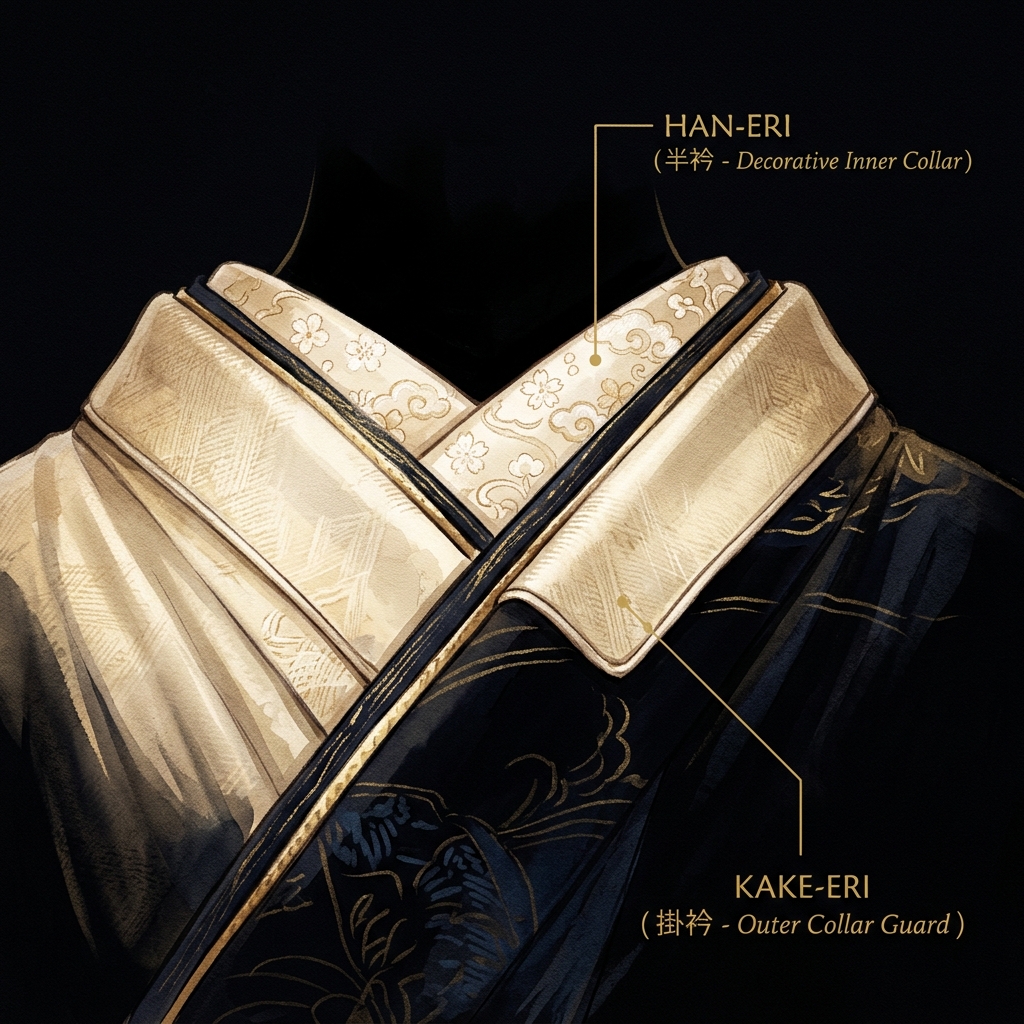
6 terms
Collar & Neckline
Loading...
合わせ衿Awase-eri
Collar Overlap
Where the left and right collar panels meet. Always left-over-right for the living.
衿足Eri-ashi
Collar Length
The measurement of the collar from the joining point to its end.
衿芯Eri-shin
Collar Stiffener
A stiff insert placed inside the collar to maintain its shape and structure.
伊達衿Date-eri
Decorative Collar
An additional decorative collar layer placed between the kimono collar and han-eri for added color.
共衿Tomo-eri
Matching Collar
A collar made from the same fabric as the kimono body.
抜き紋Nuki-mon
Resist-dyed Crest
Family crests (mon) placed on the collar area of formal kimono using resist-dyeing technique.
🎀

Obi & Accessories

帯と帯周り

The obi sash is the centerpiece of kimono styling — an art form in itself with dozens of tying methods.
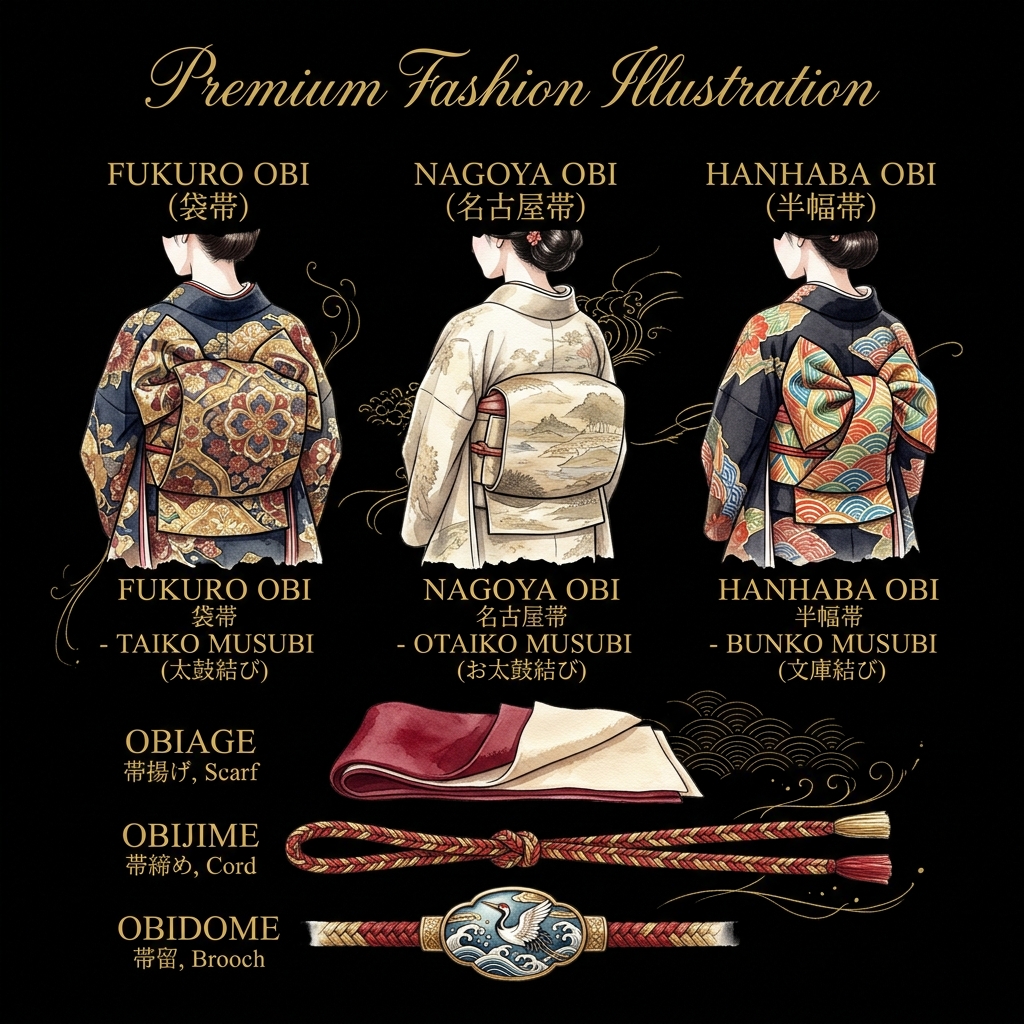
11 terms
Obi & Accessories
Loading...
Obi
Sash / Belt
The wide sash worn around the waist to secure the kimono. Obi are works of art in their own right.
丸帯Maru-obi
Full-width Obi
The most formal obi type, fully patterned on both sides. Traditionally used for bridal wear.
袋帯Fukuro-obi
Double-fold Obi
A formal obi with pattern on the outer surface only. The standard choice for formal occasions.
名古屋帯Nagoya-obi
Nagoya Obi
A semi-formal obi that is partially pre-folded for easier tying. Invented in the Taishō era.
半幅帯Hanhaba-obi
Half-width Obi
A casual, narrow obi about 15-17cm wide. Used with yukata and casual kimono.
帯締めObijime
Obi Cord
A decorative braided cord tied over the obi to secure it in place.
帯揚げObiage
Obi Scarf
A silk scarf tucked into the top of the obi, partially visible above the obi's upper edge.
帯留Obidome
Obi Brooch
A decorative clasp or brooch threaded onto a flat obijime cord.
帯枕Obimakura
Obi Pad
A small cushion placed behind the obi to support and shape the bow (musubi) or drum (taiko).
帯板Obi-ita
Obi Board
A stiff board inserted behind the front of the obi to keep it smooth and wrinkle-free.
太鼓結びTaiko-musubi
Drum Knot
The most common obi tying style, forming a rectangular "drum" shape at the back.
🌸

Patterns & Motifs

文様と柄

Every pattern on a kimono carries deep symbolism — from seasonal flowers to auspicious geometric designs.
10 terms
Patterns & Motifs
Loading...
Gara
Pattern
The general term for patterns and motifs on kimono fabric.
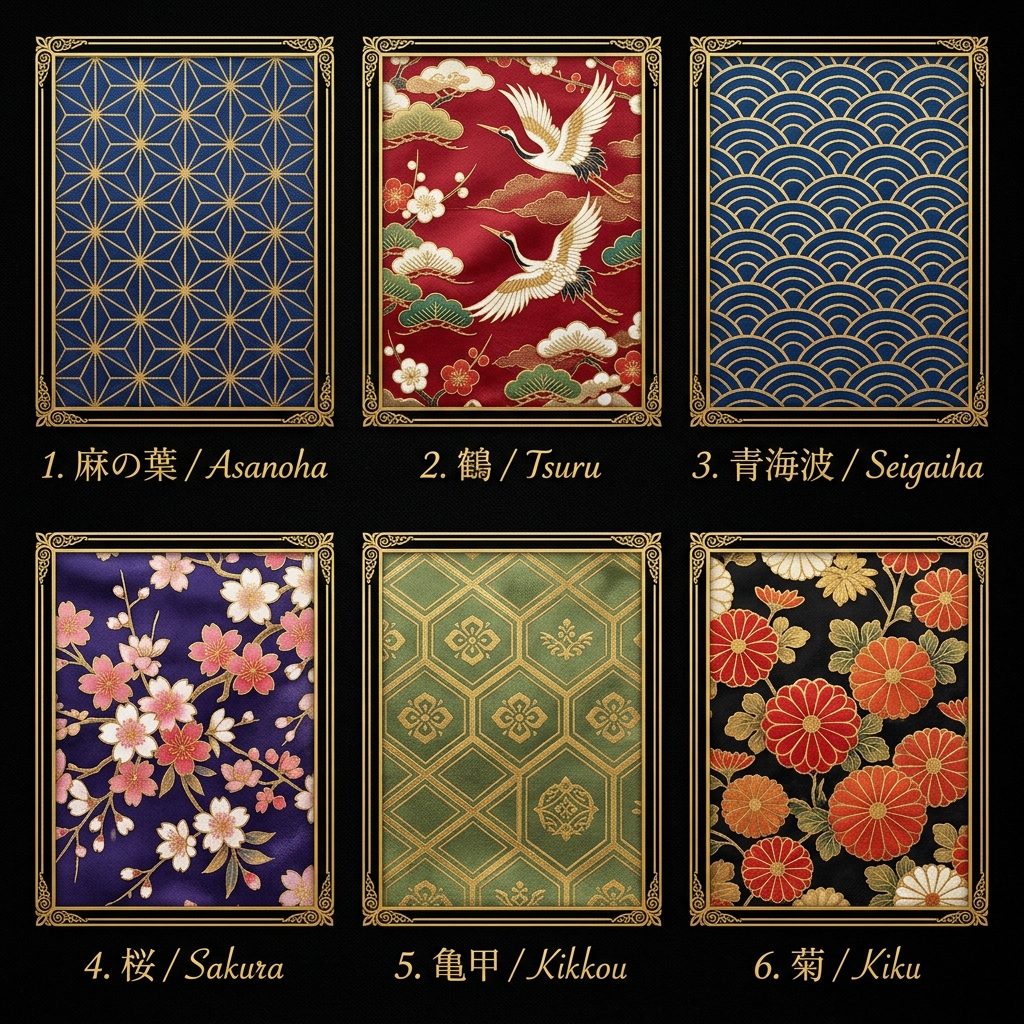
Sakura
Cherry Blossom
The most iconic Japanese motif, representing the beauty and transience of life.
Tsuru
Crane
A symbol of longevity, fidelity, and good fortune. Common on bridal and formal kimono.
青海波Seigaiha
Wave Pattern
Concentric overlapping arcs representing ocean waves — a wish for peaceful, enduring happiness.
麻の葉Asanoha
Hemp Leaf
A geometric star pattern resembling hemp leaves, symbolizing healthy growth and resilience.
亀甲Kikkō
Tortoiseshell
Hexagonal pattern resembling a tortoise shell, representing longevity and prosperity.
Kiku
Chrysanthemum
The Imperial flower of Japan, symbolizing longevity, nobility, and autumn.
牡丹Botan
Peony
The "King of Flowers," representing wealth, nobility, and feminine beauty.
Matsu
Pine
An evergreen symbol of endurance, constancy, and longevity.
Ume
Plum Blossom
Blooming in late winter, plum blossoms represent resilience, renewal, and the arrival of spring.
👡

Accessories & Undergarments

小物と下着

A complete kimono outfit requires numerous accessories — each with its own traditions and rules.
12 terms
Accessories & Undergarments
Loading...
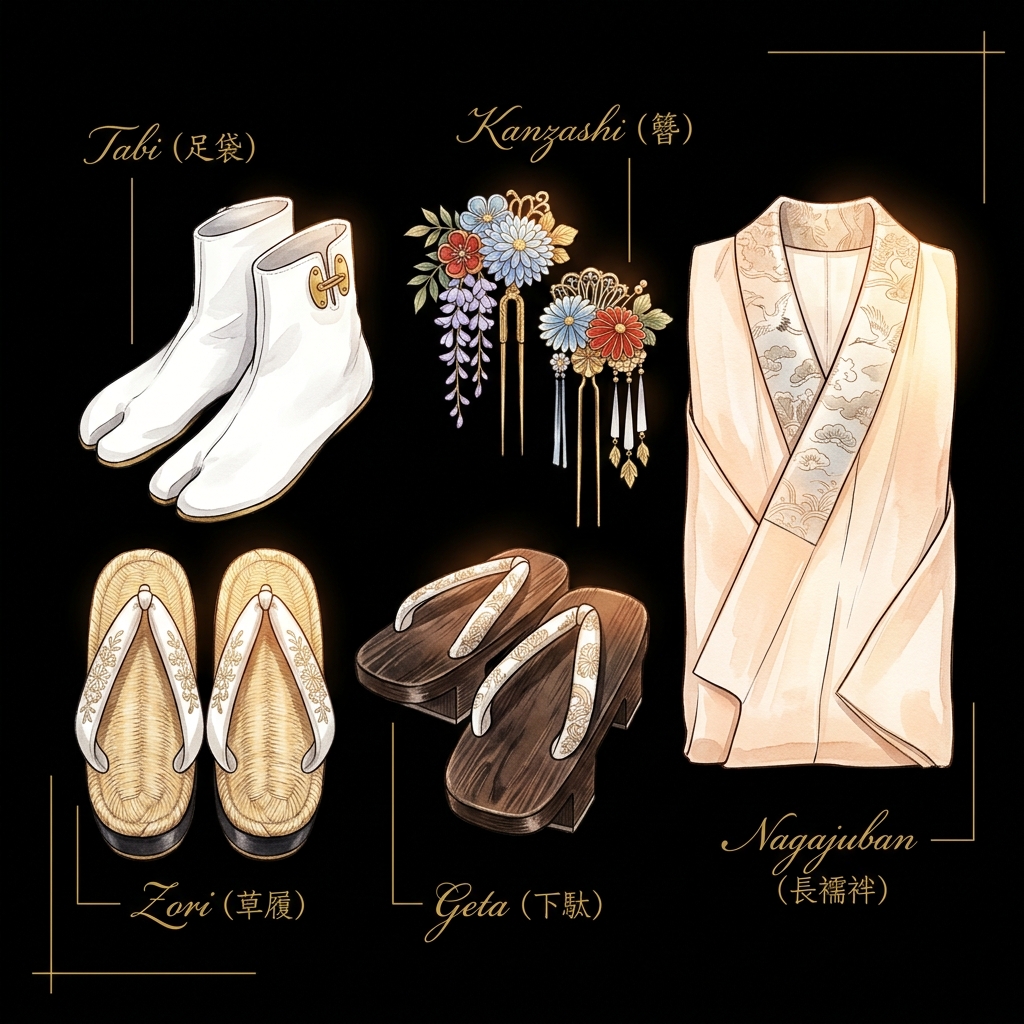
長襦袢Nagajuban
Under-kimono
A full-length undergarment worn beneath the kimono, with its own collar (han-eri) visible at the neckline.
肌襦袢Hadajuban
Undershirt
A thin cotton or gauze undergarment worn directly against the skin, beneath the nagajuban.
裾よけSusoyoke
Underskirt
A wraparound underskirt worn from the waist down, preventing the kimono from clinging to the legs.
足袋Tabi
Split-toe Socks
Traditional Japanese socks with a separation between the big toe and other toes, worn with thonged footwear.
草履Zōri
Formal Sandals
Flat or slightly elevated thonged sandals for formal and semi-formal kimono wear.
下駄Geta
Wooden Sandals
Traditional wooden platform sandals worn with yukata and casual kimono.
Kanzashi
Hair Ornament
Decorative hair pins and ornaments worn with kimono. A crucial element of the complete ensemble.
扇子Sensu
Folding Fan
A folding fan carried as part of formal kimono outfits, often purely decorative.
巾着Kinchaku
Drawstring Bag
A small drawstring pouch carried as a purse with kimono, since kimono have no pockets.
腰紐Koshihimo
Waist Ties
Thin fabric ties used to hold the kimono in place during dressing, hidden under the obi.
おはしょりOhashori
Waist Tuck
The fold of excess fabric at the waist, visible below the obi. A distinctive feature of women's kimono.
伊達締めDatejime
Under-sash
A wide, flat tie or sash worn over the koshihimo to smooth the front and help hold the ohashori.
🧵

Fabric & Construction

生地と仕立て

Understanding kimono construction reveals the ingenuity of a garment system designed for zero waste and generational longevity.

8 terms
Fabric & Construction
Loading...
Tan
Bolt of Fabric
A standard bolt of kimono fabric, approximately 36-40cm wide and 12-13 meters long.
Nuno
Fabric/Cloth
General term for textile fabric. Kimono fabrics include silk (kinu 絹), cotton (momen 木綿), linen (asa 麻), and synthetic fibers.
Awase
Lined Kimono
A fully lined kimono worn from October through May (cooler months).
単衣Hitoe
Unlined Kimono
A single-layer, unlined kimono worn during transitional months (June and September).
薄物Usumono
Sheer Kimono
Translucent, sheer-fabric kimono for the hottest months (July-August).
友禅Yūzen
Paste-resist Dyeing
An elaborate dyeing technique using rice-paste resist to create detailed pictorial designs.
絞りShibori
Tie-dyeing
Traditional resist-dyeing technique using binding, stitching, or clamping to create patterns.
西陣織Nishijin-ori
Nishijin Weaving
Luxury brocade weaving from the Nishijin district of Kyoto, used primarily for obi.
🎨

Famous Dyeing Kimono

日本の名染め着物

The great dyeing traditions of Japan — each region developed its own distinctive philosophy of beauty, passed down through centuries of master craftsmanship.
5 terms
Famous Dyeing Kimono
Loading...
加賀友禅Kaga Yūzen
Kaga Yuzen Dyeing
A refined paste-resist dyeing technique from Kanazawa, characterized by highly realistic depictions of nature with distinctive outlining and color gradation.
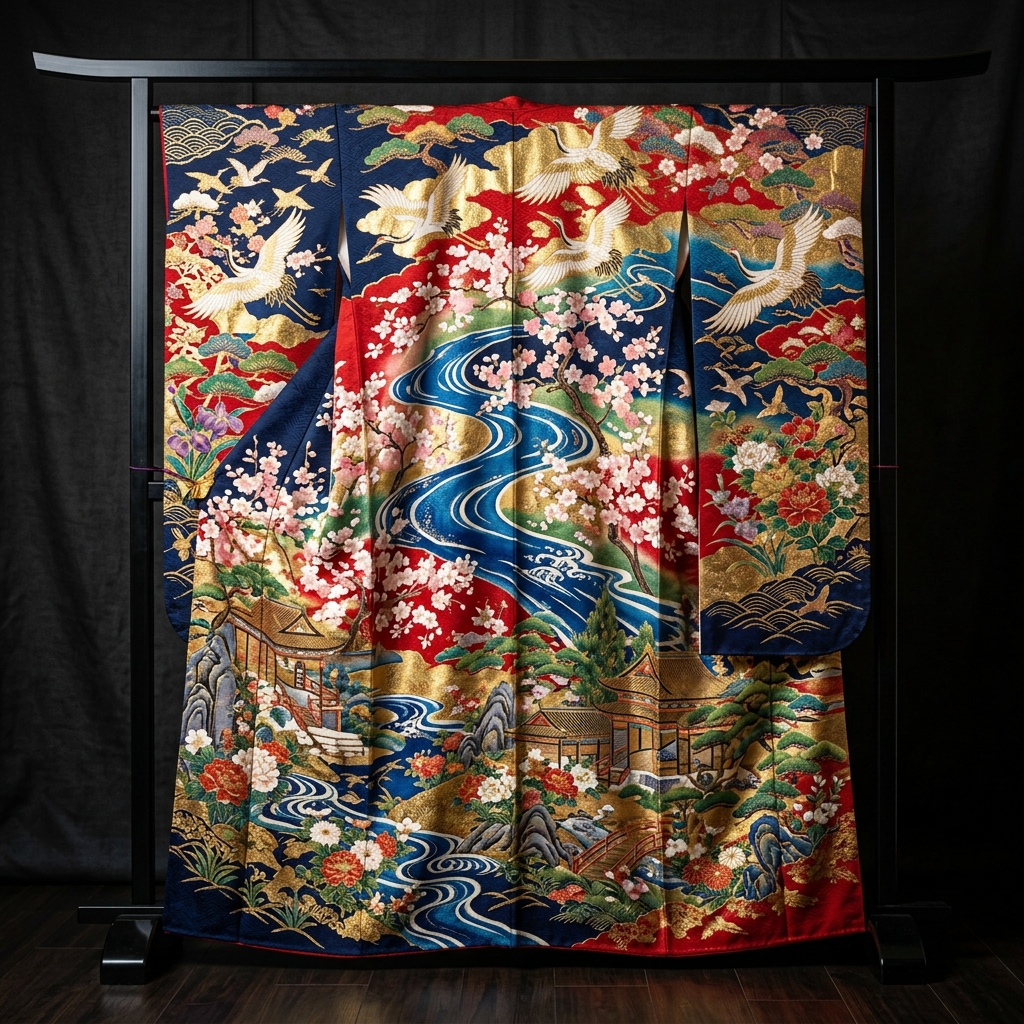
京友禅Kyō Yūzen
Kyoto Yuzen Dyeing
The most opulent and celebrated kimono dyeing tradition in Japan. Known for vivid multi-color designs, extensive use of gold leaf, and elaborate pictorial compositions.
東京友禅Tōkyō Yūzen
Tokyo Yuzen Dyeing
An urban, refined dyeing tradition embodying the Edo aesthetic of "iki" (粋) — chic sophistication and restrained elegance.
辻が花Tsujigahana
Phantom Flower Technique
A legendary, mysterious dyeing technique from the Muromachi–Momoyama period combining shibori tie-dyeing with hand-painting. Called the "phantom technique" because it disappeared for 300 years.
江戸小紋Edo Komon
Edo Fine-Pattern Stencil
An extraordinarily refined stencil-dyeing technique producing microscopic repeating patterns so fine that the kimono appears to be a solid color from a distance.
🧶

Famous Woven Kimono

日本の名織物

Japan's woven textile traditions — from mud-dyed silks of subtropical Amami to snow-bleached ramie of Okinawa, each reflecting its region's soul.
7 terms
Famous Woven Kimono
Loading...
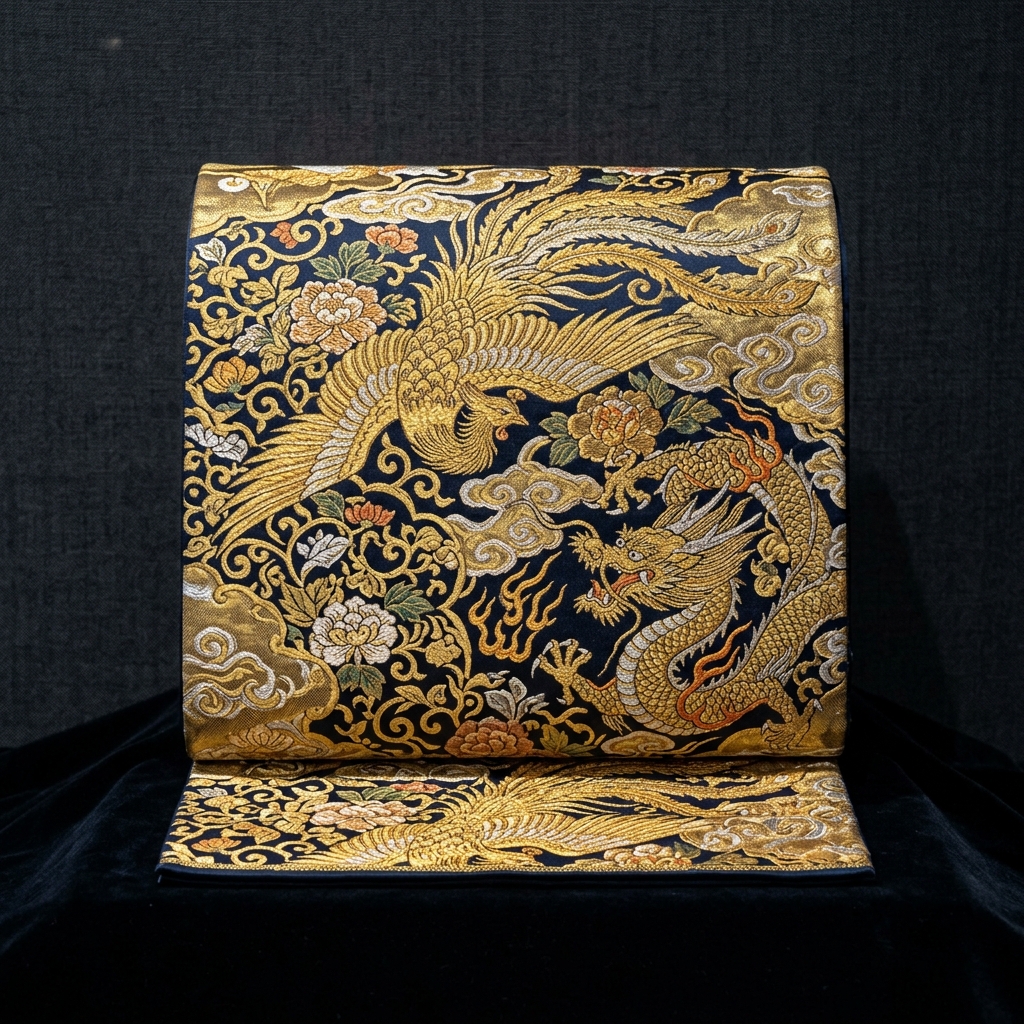
西陣織Nishijin-ori
Nishijin Brocade
The supreme weaving tradition of Japan. Famous for breathtaking gold and silver brocade obi that have adorned royalty for over a millennium.
大島紬Ōshima Tsumugi
Oshima Pongee Silk
A luxurious hand-woven pongee silk famous for its unique mud-dyeing (泥染め dorozome) that produces a distinctive deep chocolate-brown with an incomparable silken sheen.
結城紬Yūki Tsumugi
Yuki Pongee Silk
Japan's oldest surviving textile tradition (2,000+ years). UNESCO Intangible Cultural Heritage. Entirely hand-spun, hand-woven silk that improves with decades of wear.
牛首紬Ushikubi Tsumugi
Ushikubi Pongee Silk
A rare tsumugi uniquely made from "tamamayu" (玉繭) — cocoons spun by two silkworms together, creating an extraordinarily strong double-thread.
塩沢紬Shiozawa Tsumugi
Shiozawa Pongee Silk
A distinctive tsumugi from Niigata's heavy snowfall region, featuring fine kasuri patterns. Part of the famous Echigo textile trio.
久留米絣Kurume Kasuri
Kurume Ikat Cotton
A beloved indigo-and-white cotton fabric from Fukuoka, with warm rustic geometric patterns created through the kasuri (ikat) pre-dyeing technique.
宮古上布Miyako Jōfu
Miyako Premium Ramie
The finest ramie fabric in the world, woven on Miyako Island, Okinawa. So thin and translucent it's called "fabric woven from wind." A National Important Intangible Cultural Property.
🔬

Special Techniques

特殊技法

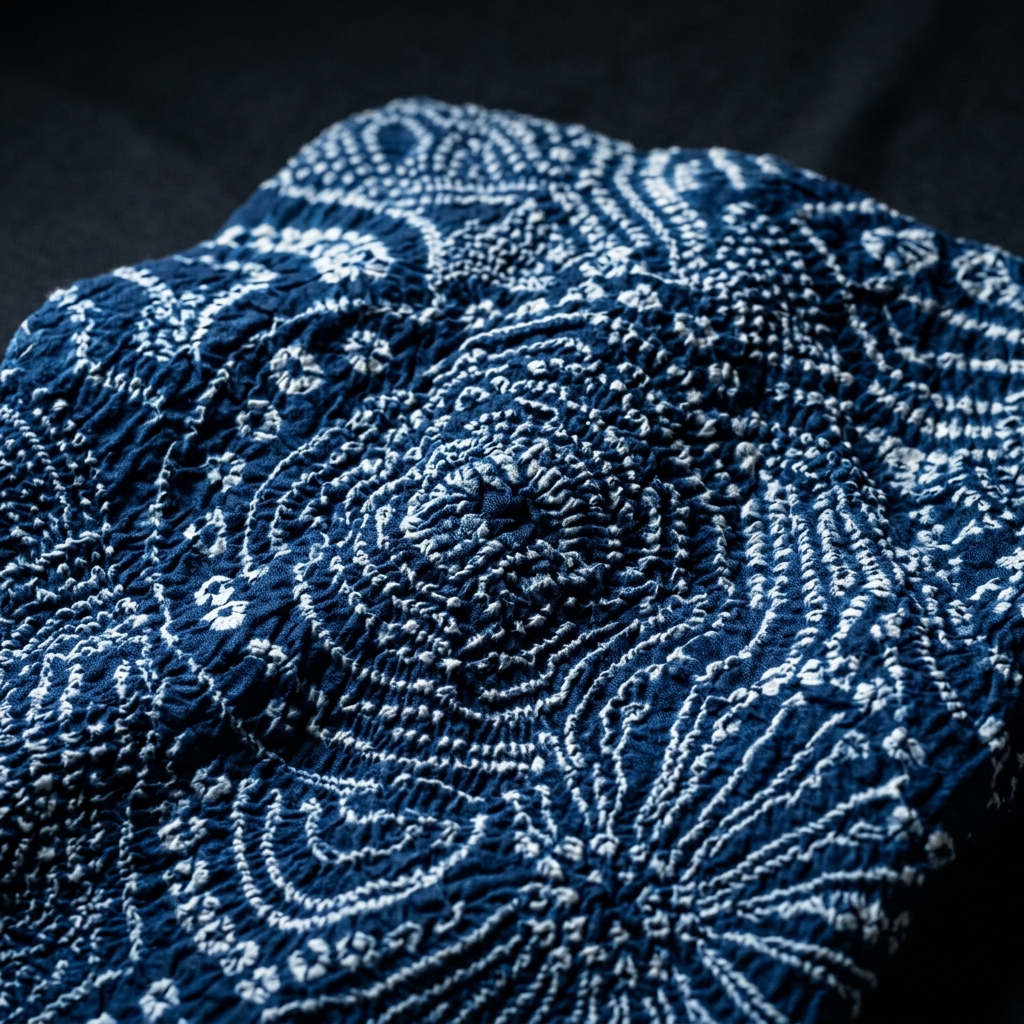
Exceptional dyeing and decorative techniques — from microscopic stencil patterns to three-dimensional tie-dye sculptures.
2 terms
Special Techniques
Loading...
有松鳴海絞Arimatsu Narumi Shibori
Arimatsu Tie-Dye
Japan's most celebrated shibori tradition, preserving over 100 distinct binding techniques that create stunning three-dimensional textured fabrics.
型友禅Kata Yūzen
Stencil Yuzen
A stencil-based adaptation of hand-painted yūzen, enabling beautiful multi-colored designs at more accessible price points while maintaining handcrafted character.